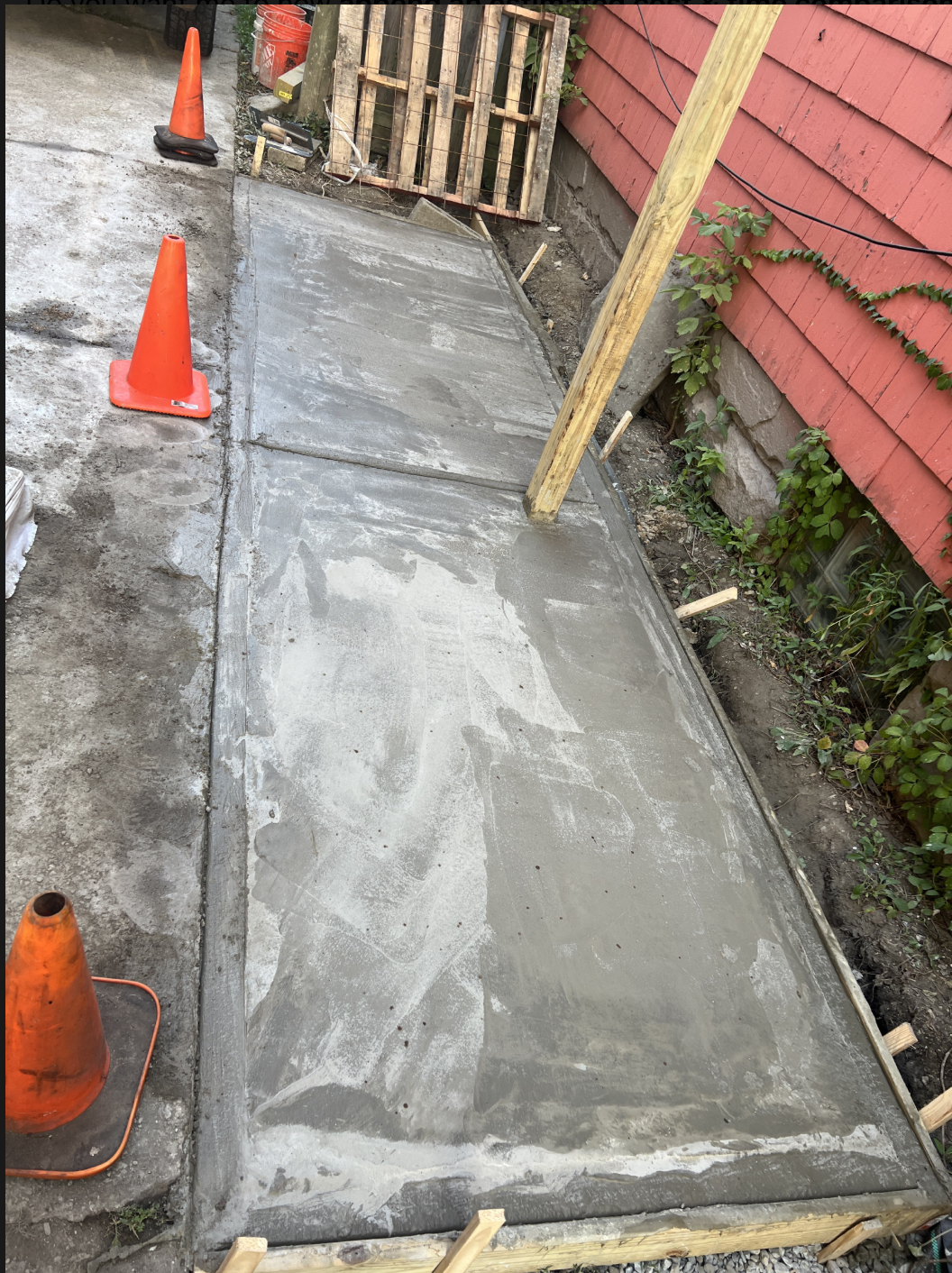
Full Build Log & Lessons Learned
Day 1–2: Framing & Base Prep
The initial work focused on building and squaring the frame. Instead of going straight into gravel leveling, I learned it’s far more efficient to:
- Build the frame first.
- Set it in place on the ground.
- Level directly with the frame as the guide.
For this job, I used deck boards instead of 4×4 lumber, which provided the exact clearance for about 4 inches of concrete above the compacted gravel layer. Wire mesh reinforcement was placed across the frame, and rebar was later removed to match the final design.
Day 3: Gravel & Layout
- Spread and leveled the gravel base.
- Ensured mesh stayed elevated within the slab thickness.
- Set stakes to keep frame stable during pour.
This work took about 4 hours, but could’ve been done much earlier in the process to save an entire day.
Day 4: Pour Day
Equipment:
- Home Depot–rented mixer ($75/day), capacity: 4 × 80 lb bags.
- 45 total bags of premixed concrete.
- 5-gallon buckets (marked for precise water measurement — 2.9 inches down from rim = 4 gallons).
Process:
- Added 4 gallons of water to mixer.
- Added first bag, mixed briefly.
- Added second bag, mixed, repeated until mixer capacity reached.
- Emptied into form, leveled immediately.
Pouring started at 4:00 PM and ended 7:10 PM — 3 hours of pouring, followed by extensive cleanup of the mixer and tools. With travel and material runs, it was a 7-hour total day.
Lesson:
Opening the concrete bags from the flat side with a mallet would have saved huge amounts of time. The first 12–16 bags were slow due to poor bag opening technique.


Day 5: Finishing & Curing
After the pour:
- Smoothed the surface with hand trowel.
- Created expansion joint between sections.
- Lightly misted slab to maintain moisture.
12 hours after pour, I covered slab to slow curing:
- Used GAF FeltBuster synthetic roofing underlayment.
- While not a curing blanket, it slowed evaporation.
- Plan to mist twice a day for 72 hours.

Final Notes & Future Improvements
- Remote guidance is better if it’s on a live video call. My helper, Bárbara (“Barba”), gave tips remotely, but real-time visual feedback would have avoided repeated mistakes.
- Framing first is the golden rule — it saves time and simplifies leveling.
- Bag handling — Cut flat, loosen with mallet before pouring into mixer.
- Consider ready-mix delivery — For a similar job (16 ft × 50 ft), research costs for a truck + crew. The time savings could outweigh the cost difference.
- Curing — For best results, use plastic sheeting or proper curing blankets over FeltBuster to trap moisture.