
Stop Selling Nights: The Next Yield Opportunity in Short-Term Rentals
It is 10:00 a.m. in Cleveland. You need a place to shower, lay your head for a few hours, and get back on the road.
What do you do?
Who do you implore for an early check-in?
Even if there is inventory available, you may be about to pay 25% extra—or more—for the privilege of getting into a room a few hours earlier. Or you can simply drive away.
That makes very little economic sense.
A room could be completely vacant, clean, and technologically ready at 10:30 a.m., yet commercially unavailable to somebody who needs accommodation from noon until 5:00 p.m.
Likewise, someone arriving in Cleveland at 1:30 a.m. may genuinely need a room right now. Yet the architecture of Airbnb, Booking.com, Vrbo, Expedia, and other OTAs can make that surprisingly awkward.
Why?
Because the system thinks primarily in dates and nights rather than occupancy intervals.
The Brazilian Motel Already Solved This
There is an analogy I find incredibly useful here: the Brazilian-style motel.
Not because I am proposing that we turn short-term rentals into motels. I am not.
The analogy matters because Brazil has had a mature lodging industry operating with a different concept of time for decades.
The conceptual shift is incredibly simple:
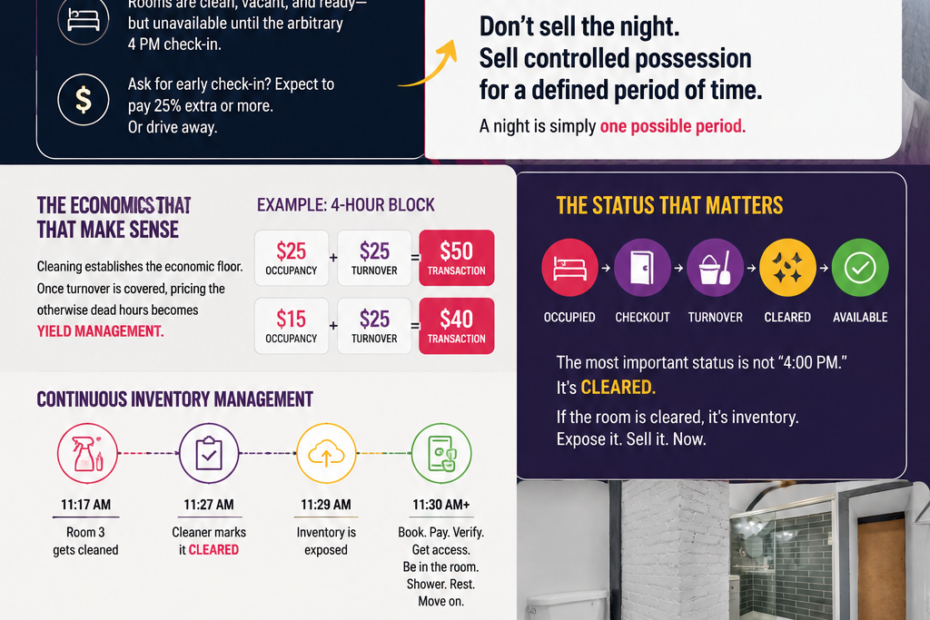
Don’t sell the night. Sell controlled possession of the room for a defined period of time.
A night is simply one possible period.
That changes the economics dramatically for a particular kind of operator: the operator of high-turnover furnished accommodations where the average reservation may be three nights or less, but repeat customers generate dozens of nights annually—sometimes year after year.
Economically, that starts looking much more like an accommodation network than the traditional idea of someone occasionally renting a vacation home.
And, may I suggest, it is an underserved market.
Start With Four Hours
Let’s look at the economics.
Suppose the normal economics of a room are roughly $50 to $60 per night.
A four-hour occupancy block does not necessarily need to cost 4/24ths of the nightly rate. That would be the wrong way to think about it.
Instead, the product could have a minimum occupancy charge plus a turnover charge.
Maybe it is:
$25 occupancy + $25 turnover = $50 transaction
Or:
$15 occupancy + $25 turnover = $40 transaction
The critical insight is that cleaning establishes the economic floor.
What does it cost to pay the person doing that job an economically feasible and dignified amount to come in, turn that room, and make it ready for the next person?
Start there.
Cover the turnover. Cover your required profit. Everything beyond that becomes pricing of hours that otherwise may have generated exactly $0.
That is where this becomes yield management.
And yield management is the critical term here.
Forget 4:00 PM. Is the Room Cleared?
The status of a room could effectively become:
Occupied → Checkout → Turnover → Cleared → Available
That changes what the operator cares about.
The most important status is no longer:
“Will the room be ready by 4:00 p.m.?”
It becomes:
“Is the room cleared?”
If it is cleared, it is inventory.
If a room is sitting in checkout status and nobody has picked up the turnover, that task is available for someone to pick up, turn quickly, mark cleared, and put back into inventory.
Now we are talking about continuous inventory management.
Take Room 3.
The guest checks out at 5 a.m.
The room gets marked avaialble to clean at 5:01AM
At 5:25 AM Erica, who is coming off shift from Amazon decides to make extra 25 bucks for 30 minutes of work on the way home.
At 6:15 AM Erica arrives and checks in to the Room, and proceeds to follow the cleaning procedure
At 6:37 AM Erica is sitting on the driveway, marking the room CLEARED.
The booking ENGINE immediately exposes the inventory.
Someone searching at 06:48 a.m. 10 20 miles out or on the end of their shift could now reserve the room for the next four hours, eight hours, overnight, three days, or potentially three weeks—beginning immediately. That person that says.. “need a rest stop now with a shower, but there are no Loves around, and I really would love to lay down on a proper bed.
Payment is processed.
Verification is completed.
Smart-lock credentials are generated.
Instructions are delivered.
A person can be in the room, showering, laying down, and chilling in 30 minutes or less—at virtually any time of the day or night.
There Is No Early Check-In
This leads to what I think is one of the most important distinctions in the entire concept:
The guest isn’t buying an early check-in.
There is no early check-in.
They’re buying inventory beginning at the moment that inventory becomes available.
That’s a huge distinction.
And much of the technological groundwork already exists.
Many short-term rental operators already use self-check-in. Smart locks are everywhere. Payments are automated. Guest verification can be automated. Messaging is automated. Cleaning tasks can be dispatched digitally.
Nobody needs to be standing behind a front desk handing someone a brass key.
That makes rapid-turnover inventory management considerably more plausible operationally today than it would have been even a decade ago.
It is particularly interesting for operators with concentrated inventories of private rooms, suites, apartments, and other furnished accommodations rather than geographically scattered vacation homes.
The Repeat Guest Changes Everything
But the repeat guest may be the most important part of this thesis.
We have guests who stay more than 50 nights annually with us while frequently staying fewer than four nights at a time.
Think about that.
Calling that person a short-term rental guest actually obscures what that person is.
They’re a recurring lodging customer.
From a physical human standpoint, they are about as close to SaaS recurring revenue as lodging gets.
The construction worker.
The consultant.
The healthcare worker.
The traveling technician.
The airline employee.
The gig worker.
The separated partner.
The regional salesperson.
The person who repeatedly needs somewhere clean, comfortable, safe, convenient, furnished, and predictable—but doesn’t necessarily need it for 30 consecutive days.
The individual transactions are short-term.
The customer relationship is long-term.
That distinction matters enormously.
The Night May Be the Wrong Unit of Inventory
The next major efficiency gain in high-turnover short- and mid-term rentals very likely will not come from squeezing another $3 out of nightly pricing.
It may come from abandoning the night as the smallest sellable unit of inventory.
The Brazilian motel industry provides a decades-old proof of concept that lodging inventory can be sold, occupied, turned, cleaned, reopened, and repriced continuously.
It does not have to remain hostage to an arbitrary 4:00 p.m.-to-10:00 a.m. hospitality clock.
And this is considerably bigger than what someone might dismissively call “hourly Airbnb.”
The opportunity is time-based yield management applied to distributed furnished lodging: comfortable, safe, convenient, well-located housing sold according to when it is actually available.
If the room is cleared, the room is inventory.
Why are we waiting until 4:00 p.m. to sell it?
About the Author
Jay Silva is an operator, entrepreneur, and management consultant exploring the intersection of hospitality, technology, pricing, and high-turnover furnished accommodations.
Key question: How many dead hours do I actually have, how many of them are commercially sellable, and what percentage can I convert without cannibalizing the business I already have?
Comments are closed.