Why Do People Who Need Money the Most Often Make the Most Expensive Decisions?
Observations from more than 10,000 Airbnb nights per year.
Over the better part of a decade, I’ve operated affordable accommodations in Cleveland.
During that time, our company has hosted tens of thousands of reservation nights. More importantly, we’ve welcomed thousands of unique guests.
This isn’t an academic study.
It’s a front-row seat to how ordinary people live.
More than 63% of our guests tell us they chose Stay With Jay for one simple reason:
We were the most affordable option.
That matters because affordability isn’t just our marketing strategy—it’s our operating philosophy.
We intentionally try to keep our guests’ total housing costs low.
A one- or two-night stay often works out to under $60 per night.
Longer weekly stays approach $50 per night.
Monthly stays can fall to approximately $45 per night.
Those prices include utilities, Wi-Fi, parking, laundry, and weekly room turns. We try to eliminate the hidden expenses that quietly make life more expensive.
Yet something fascinating happens after guests arrive.
The Paradox
Many guests work hard to save $10 choosing an affordable room.
Then spend $30 on Uber.
Twice.
Sometimes three times.
The next morning, instead of cooking in a fully equipped kitchen, breakfast arrives through DoorDash.
Lunch comes through Uber Eats.
Dinner follows.
None of these choices, by themselves, are irrational.
I use Uber.
I order delivery.
Most people do.
The difference is frequency.
When transportation costs exceed housing costs…
when convenience becomes a daily habit…
small decisions become expensive lifestyles.
The Popcorn Guest
One pattern appears again and again.
Internally, I call them “popcorn guests.”
They bounce from one reservation to another.
One night here.
Two nights there.
Another booking somewhere else.
Then back again.
Some have accumulated more than 200 nights with us over several years.
One guest had over 40 check-ins and check-outs in just ninety days.
That isn’t unusual in affordable housing.
What fascinates me isn’t the number of stays.
It’s the consistency of the surrounding decisions.
The Math Doesn’t Care
Suppose transportation averages $30 per day.
Housing averages $53.
Before food, before clothing, before your phone bill…
life already costs $83 every day.
Round that to roughly $100 after taxes and income requirements.
That’s approximately $3,000 per month before eating.
Now add restaurant meals because the kitchen sits unused.
The financial picture changes dramatically.
Again…
None of these decisions are individually catastrophic.
Together, they become a system.
This Isn’t About Blame
It’s easy to say,
“They should just cook.”
“They should ride the bus.”
“They should budget better.”
Reality is rarely that simple.
Time.
Stress.
Mental bandwidth.
Transportation.
Neighborhood safety.
Work schedules.
Childcare.
Energy after a twelve-hour shift.
All influence decision making.
Understanding behavior is far more valuable than judging it.
What If Hospitality Could Help?
This question has become increasingly important to me—not just as a host, but as a business owner.
If we understand these patterns…
could we design an environment that naturally leads to better outcomes?
Not by forcing behavior.
By reducing friction.
Perhaps the answer isn’t cheaper rooms.
Perhaps it’s helping guests use the kitchens more often.
Maybe it’s highlighting nearby grocery stores the day before check-in.
Maybe it’s surfacing bus routes inside the guest portal.
Maybe it’s sending targeted promotions based on length of stay.
Maybe it’s helping repeat guests consolidate bookings instead of constantly moving.
Maybe it’s introducing referral programs or loyalty rewards that reinforce financially healthy behaviors.
The point isn’t to tell people how to live.
The point is to design hospitality that makes the better choice the easier choice.
Subscription Behavior Without a Subscription
Here’s another observation.
Stay With Jay is not a subscription business.
Yet roughly 60% of our revenue comes from guests who behave like subscribers.
They return.
Again.
And again.
And again.
Every reservation is another vote of confidence.
They trust us enough to sleep under our roof.
That trust is incredibly valuable.
It also creates an opportunity.
Not simply to earn another reservation.
But to improve the guest’s experience beyond the room itself.
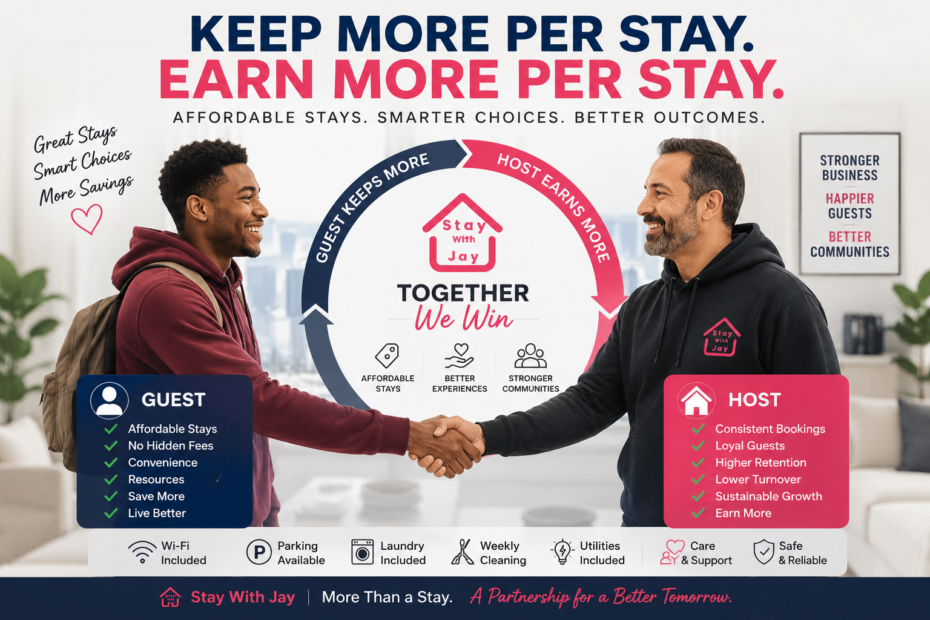
Keep More Per Stay. Earn More Per Stay.
The lesson isn’t that poor people make poor decisions.
The lesson is that everyone makes decisions within the environment they’re given.
If we can design that environment better…
our guests may keep more of what they earn.
And if our guests keep more…
they’re more likely to return.
That creates a rare outcome where everyone’s interests align.
Guests build greater financial stability.
We build a stronger business.
Communities become healthier.
Sometimes the best hospitality isn’t a nicer room.
It’s helping someone leave with a little more money than they would have otherwise.
Keep More Per Stay. Earn More Per Stay.